My main issue is energy. The graph above is twelve weeks of daily ratings from TriLog, August through mid-October. (Twelve weeks is the maximum the exported web dashboard can show; the desktop viewer can go longer. I’ve got more than a year of data behind this strip.) 4 or 5 means I’m doing pretty good. 1 or 2 means I could barely get out of bed.
The good news is the slumps are short, and I always recover. The bad news is, it’s hard to plan things when you don’t know how much energy you’re going to have. The recoveries are predictable but not when the slump is going to hit. But it helps seeing that the problem is limited.
Back in 2005 I read an article in the New York Times about a guy who tracked a number of things, including how much time he sat, and decided that it linked up with his health. (Does the Truth Lie Within?)
I don’t have the patience to keep a spreadsheet like that, and besides, I don’t get sick that often, but I thought that was interesting.
When vibe coding started getting practical last autumn, I thought it would be a good idea to create an app for tracking energy easily. I’m a professional software developer, but without AI I wouldn’t have been able to take this project on. I didn’t have experience with iPhone apps and this one is pretty complicated. However, since now I can add features as soon as I think of them, I’ve been able to build this and iterate on it until it does everything I want it to do and is customizable for any kind of tracking.
How it grew
First, I started with energy. Then I decided I should probably add mood, because those two can be linked. Then I realized I need activity, because at the very least I need to track sleep. For me, devices don’t seem to pick up my sleep very well, so I need to actually track it. That made energy, mood, and activity: TriLog.
Then I figured it’d be good to add in some other external metrics and see if they line up. One theory I had was that a drop in air pressure, or a pollen spike, would cause me to have a tired day. So I added weather (pollen, air pressure, temperature) and Apple Watch data like heart rate variability. I made metrics grid so I could put my energy ratings in the same columns as those signals. You pick which rows show, and you can see how they correlate.
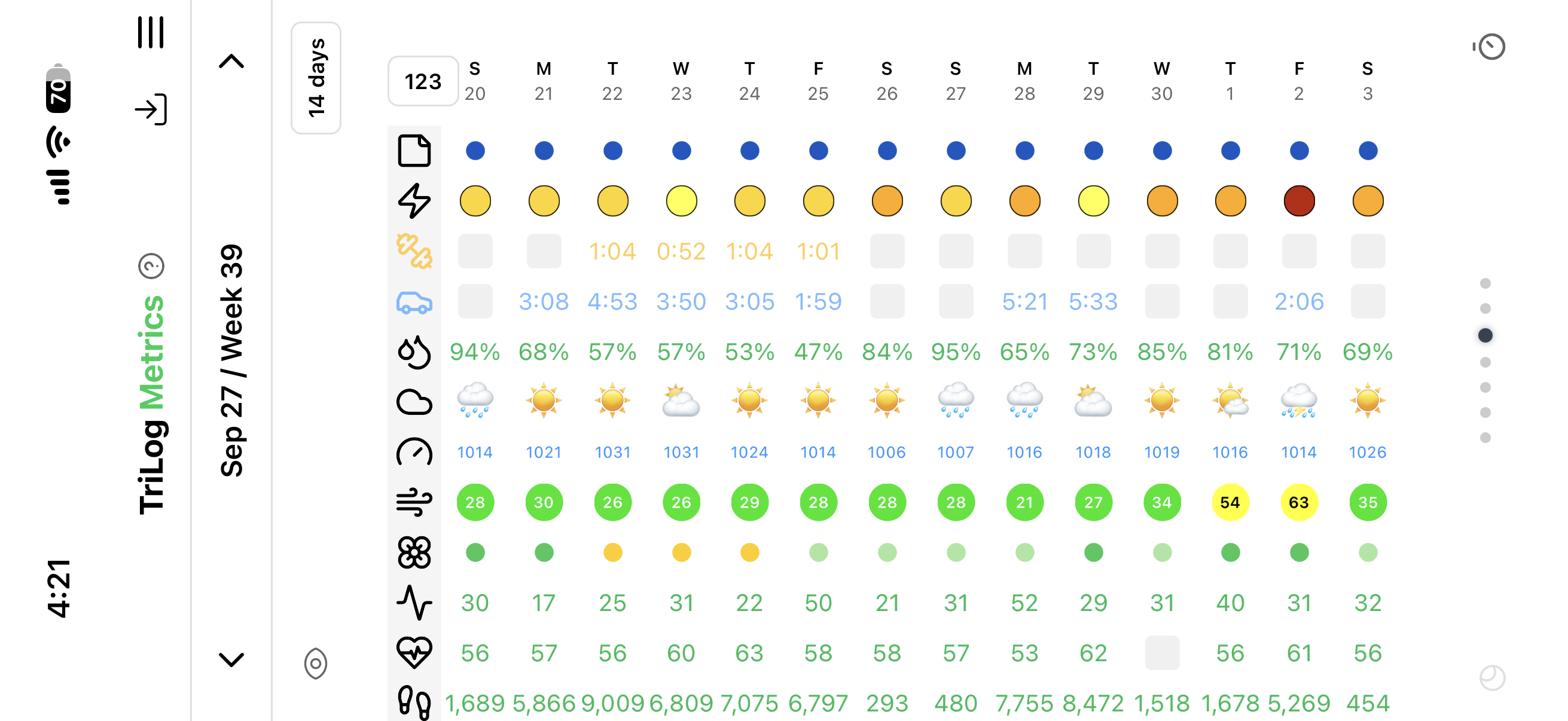
Air pressure changes and pollen didn’t end up showing any relation to my energy. But it was useful to be able to rule out those theories.
I also added the ability to enter a note with any entry, then custom trackers for anything that didn’t fit a one-line note. A headache, for example, isn’t just a severity number at noon. It has a start and a stop, and shows up as a band for as long as it lasted. Same pattern works for other symptoms, or for anything else you define. Meals, caffeine, journal fragments still live as notes alongside that.
So now TriLog is a place for autobiographical data generally: energy and mood, symptoms, intake, diary entries, whatever you decide belongs in the log.
How I’m using it today
Besides the basics and short diary notes, I’m tracking caffeine intake, meals, and other things. I also use it to track trial interventions. For example, this tweet from Dan Go made me decide to try glycine before bed. That one seemed to help, so I moved it over to the Habits section.
Another thing I tried was L. reuteri yogurt, after reading this note from Sasha Chapin. That resulted in an immediate, complete crash for four days. Could be a coincidence, but I’ve got the record of the correlation and will give it another try in a while.
Some thoughts on energy
It seems to me that subjective energy is the most important single factor in being alive, in well-being. It’s how brightly your consciousness is lit up. Of course pain, mood, and connection with reality etc. can be more important. And if you are starving, mental energy might stay decent while physical energy diverges. But other things being equal, or assuming a good foundation, mental energy is the key thing.
It’s too bad we don’t have a readout for it. Because it is subjective, there is no measure except examining one’s own subjectivity and reporting/recording it. Unreported and often unexamined, we miss how large an effect differences in this value have. If the chart at the top of this page were all fives, my life would be completely different. Probably many such cases.
Just to clarify: when I record a five, it is within what I would generally expect, not relative to some extreme state I or others might be capable of. Several cups of coffee would temporarily score a lot higher than a usual five, but it still just gets a five. And I’m not comparing myself to others, some of whom seem to have a different baseline than me. I’m just comparing to what my potential seems to be.
Variations within or between people can have a physical cause. Anyone with energy problems should investigate those with a doctor. But it seems as if there are variations that start with a mental cause, so to speak, even if the subsequent effects become physical.
In Coming Alive by Phil Stutz and Barry Michels, there is a useful frame for psychic energy and the lack of it. This book has an intuitive understanding of energy that I haven’t come across in other works on psychology.
When a psychiatrist gets a new patient, the first thing they want to know is the diagnosis – what’s wrong with this person? The first thing I want to know is what resources the patient already has – what’s right with this person? Their most important resource is their energy level. (page 118)
I’d recommend anyone with unexplained energy loss read this book. Chapter Four includes a case study of a woman whose severe lack of energy traces back to a traumatic situation she sought to mentally escape from, then compounding as important connections with the world got severed. By her thirties the link to the original event was forgotten, and the problem presented as purely physical: no longer the wish to hide from reality, but the second-order effect of disconnecting from the world.
Beth didn’t realize that the amount of energy you have depends on your relationship with the world. You create energy when you engage with the world, and you destroy energy when you withdraw from the world. (page 112)
To the extent that energy level isn’t purely physically determined, meaning that the brain is functioning as it is designed and yet energy is not what it should be, energy level is the measure that shows your potential for living, either for acting or just being aware.
Note that the TriLog app isn’t a tool for diagnosing or treating any condition by itself. It just makes it easy to keep a record, something you can read yourself, or hand to someone who knows how to interpret it, like your physician.
Some notes on AI
The TriLog app doesn’t have any AI built in; it is just for recording the data. It also pulls in some external context like Apple Health data and weather data. But once you have numbers you don’t really need AI to look at them, that’s just standard algorithms of correlation, and I’ve built those in.
There is a journal feature, and that’s the kind of free-form data that AI can be useful in hooking up to other data. But the AI doesn’t need to be in the app. You can just export everything. I’ll add some kind of connector soon, but I’m not expecting that to be a huge benefit. It’s most important just to have the record and see the patterns.
Joe Orr, New York